Ethereum trades near $2,380 heading into the Glamsterdam upgrade, scheduled for May 2026 — the biggest execution-layer fork since The Merge. Citi analysts place the near-term target at $3,175, with Standard Chartered projecting $7,500 by year-end. With accumulation wallets hitting a record 26.55 million ETH and spot ETFs booking their strongest weekly inflows of 2026, the setup favors ETH over Solana this quarter. This is not financial advice.
- Near-term ETH target $3,175 (Citi); year-end $7,500 (Standard Chartered).
- Glamsterdam upgrade scheduled May 2026 — 10,000 TPS target and 78.6% lower gas fees.
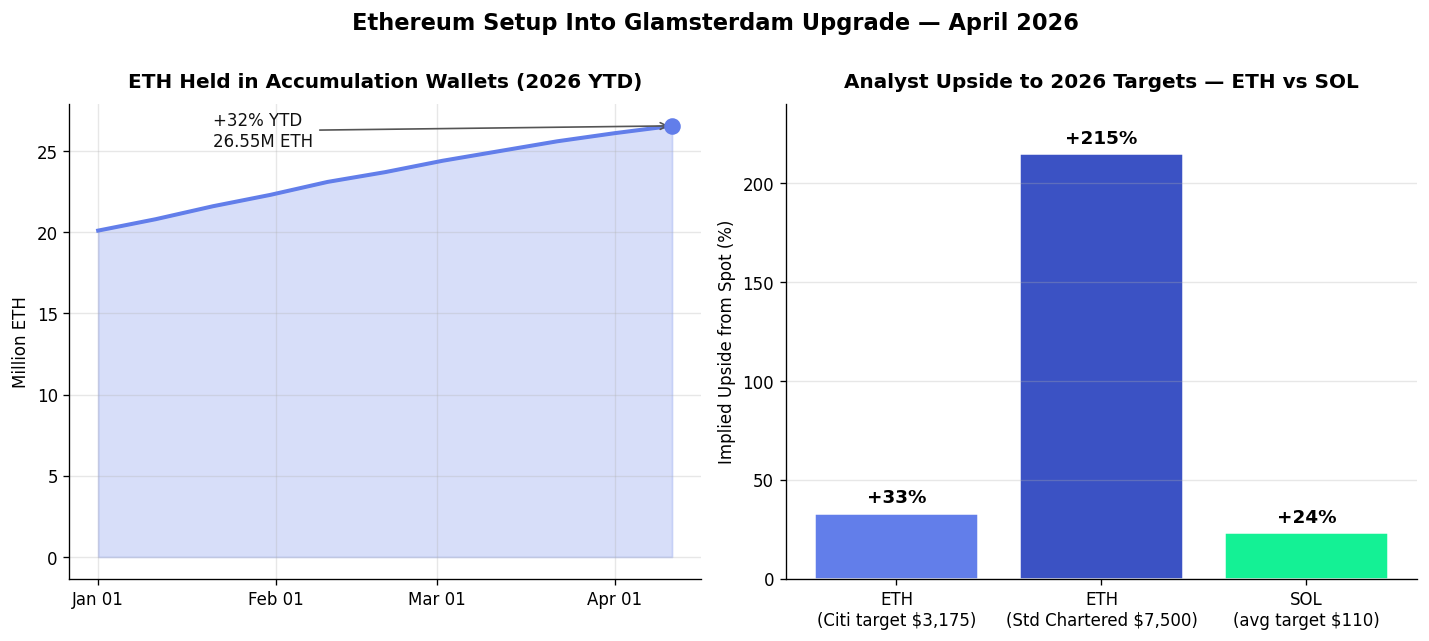
- Accumulation wallets hit a record 26.55M ETH, up 32% year-to-date.
- Spot ETH ETFs pulled $187M last week — the strongest weekly haul of 2026.
- ETH implied upside to Standard Chartered target is 215% vs SOL’s 24% upside to $110 consensus.
The Catalyst — Glamsterdam Arrives in May
The Glamsterdam hard fork is scheduled for May 2026, Ethereum’s biggest execution-layer overhaul since The Merge. The upgrade introduces Enshrined Proposer-Builder Separation, on-chain block building, and Block Access Lists — changes that together target 10,000 transactions per second and a 78.6% reduction in gas fees.
Vitalik Buterin’s February EIP package raises the per-block gas limit from 60 million to 200 million and shifts Ethereum toward multi-core execution where independent transactions run in parallel. The later Hegota upgrade in H2 2026 adds a second shot on goal. For the full roadmap, see FinanceFeeds’ breakdown of Ethereum’s locked-in Glamsterdam and Hegota timeline.
Tom Lee of Fundstrat called ETH “severely undervalued” near $3,000, while Citi published a $3,175 base-case target for 2026. Standard Chartered maintains a $7,500 year-end call. ETH has historically rallied 20–40% in the six to eight weeks before major upgrades.
On-Chain Data Backs the Bull Case
ETH held in accumulation wallets has climbed from 20.1 million on January 1 to 26.55 million as of April — a 32% gain in 15 weeks. That’s an additional 6.5 million ETH locked away by wallets that have never sold.
Staking corroborates the accumulation. Total staked ETH hit an all-time high of 37.85 million, and on April 5 the Ethereum Foundation staked 45,000 ETH in a single day — a public shift from operational selling to yield generation. Bitmine alone has amassed 4.8 million ETH ($7.1 billion staked, $196 million in annualized staking revenue), equal to roughly 4% of circulating supply.
The setup mirrors the pre-Dencun pattern in early 2024, when ETH rallied 34% in the two months before that upgrade went live.
ETH vs Solana — Why ETH Is the Stronger Play Right Now
Ethereum trades at $2,380 with a $287 billion market cap. Solana trades near $89 with a $47 billion cap. Both have ETF narratives, but only one has a hard-fork catalyst in the next 45 days.
Glamsterdam is the difference. Solana’s scaling pitch — high throughput, low fees — loses its core selling point the moment ETH L1 lands at 10,000 TPS with 78% lower gas. Solana’s roadmap has no equivalent protocol-level catalyst in Q2 2026, and its ETF approval timeline is still pending SEC action.
The upside math is asymmetric. ETH’s implied upside to Citi’s $3,175 is 33%, to Standard Chartered’s $7,500 it’s 215%. SOL’s implied upside to its consensus $110 target is just 24%. For a portfolio targeting a known catalyst window, ETH offers more range with a cleaner dated trigger.
What Could Go Wrong
Two risks threaten the thesis. First, Glamsterdam’s tentative May timing could slip to Q3 or Q4 if testnet validation uncovers issues — a delay would force the “sell the news” crowd to exit early and expose ETH to a retrace toward $2,000 support. Second, macro tail risk from the FOMC on April 28–29 and the expiring US-Iran ceasefire could trigger a broad risk-off move. A hawkish Fed plus ceasefire collapse could send ETH back to the $1,920 zone regardless of upgrade progress.
ETH into the Glamsterdam window is a directional bet on Ethereum’s biggest execution-layer upgrade since The Merge, underwritten by record accumulation wallet balances and the strongest ETF flows of 2026. The near-term target is $3,175. The bull case stretches to $7,500 by year-end if Glamsterdam ships on time and Hegota follows. Watch the final testnet validation window in late April — that is the confirmation signal. For a complementary view on institutional positioning, see FinanceFeeds on how BlackRock’s staked ETF validates $4,000 ETH.
Frequently Asked Questions
Will Ethereum reach $3,175 in 2026?
Citi’s $3,175 base case is achievable if Glamsterdam ships on schedule and ETF inflows hold their April pace. Standard Chartered’s $7,500 year-end target needs both Glamsterdam and Hegota to land cleanly. Delay or macro shock pushes ETH toward $2,000 support.
ETH vs SOL: which is the better investment in 2026?
ETH has the clearer near-term catalyst. Glamsterdam arrives in May with 10,000 TPS and 78% lower gas — directly neutralizing Solana’s core selling point. SOL’s ETF timeline is still pending. For upside per dollar of risk into Q2, ETH wins.
What is the ETH price prediction for 2026?
Base case: $3,175 (Citi). Bull case: $7,500 (Standard Chartered) or higher per Tom Lee and Arthur Hayes. Bear case: $1,920 if Glamsterdam slips. Consensus 2026 range sits at $3,000–$5,000.