
The decentralized finance (DeFi) landscape is undergoing a significant transformation with the advent of Liquid Restaking Tokens (LRTs). Node Capital, a prominent Web3 venture fund, has released an in-depth report titled “Abstracadabra: The Liquid Restaking Over,” shedding light on the rise of LRTs and their potential to reshape the DeFi ecosystem.
The Rise of Liquid Restaking Tokens
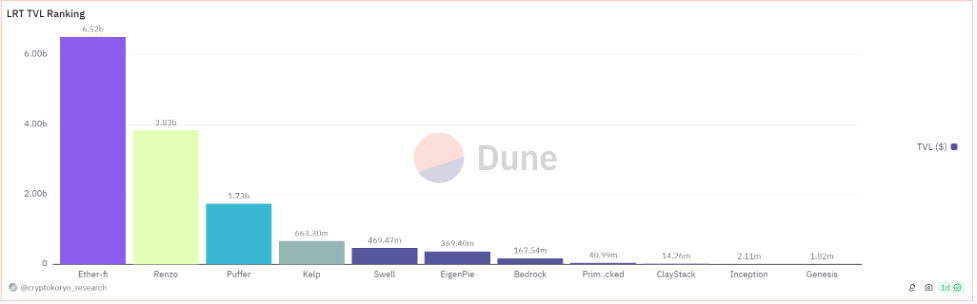
Liquid Restaking Tokens (LRTs) have emerged as a pivotal innovation in the restaking industry, simplifying the complexities of traditional Ether (ETH) staking. By offering stakers the equivalent of their staked tokens, LRTs enable the deployment of these tokens in other protocols, thereby enhancing capital efficiency in DeFi. This development has driven the total value locked (TVL) in LRTs to an astonishing $13.8 billion, a remarkable increase from $164 million at the beginning of 2024.
According to Node Capital, the shift towards LRTs is fueled by the demand for more efficient and user-friendly financial instruments. The report highlights that LRTs are not only poised to dominate the restaking landscape but also to significantly impact the broader DeFi ecosystem.

EigenLayer: A Catalyst for Growth
A key player in the LRT space, EigenLayer, has been instrumental in the growth of liquid restaking protocols. With a TVL of over $16 billion, EigenLayer alone accounts for more than 85% of the restaking industry’s total value. The protocol’s success is attributed to its ability to abstract away complexities and provide a modular approach to integrating various Actively Validated Services (AVSs).
Or Harel, Token Engineering Analyst at Node Capital, explains, “Following the ‘points rush’ for potential airdrops, the demand in EigenLayer’s deposit caps far outstripped supply. Leading liquid restaking protocols capitalized on this technical arbitrage opportunity, abstracting complexities like EigenPods management into tokens. This allowed them to attract billions in stakers’ capital and build sophisticated operator infrastructure.”
Ether.fi: Leading the Market
Ether.fi has emerged as a dominant force in the LRT market, controlling over 50% of the total market share. Its user-friendly restaking model has simplified traditional staking, making it more accessible to retail users who would otherwise need a minimum of 32 Ether to run a validator node.
The report attributes Ether.fi’s market dominance to its successful simplification of complex restaking operations into a user-friendly token model. This approach has facilitated value accrual autonomously, attracting a significant portion of the market.
Market Dynamics and Centralization Concerns
While LRTs are driving decentralization by simplifying staking processes, the report also raises concerns about potential centralization. Centralized solutions often appear as a lower-risk alternative due to their convenience, which could undermine the core principles of the crypto revolution, such as censorship resistance and trustless systems.
Node Capital’s report emphasizes the need for a more accessible decentralization force, built on the core concepts of abstraction, friction removal, and user-centric simplification. LRT protocols are well-positioned to facilitate this shift, enhancing user experience and opening up complex DeFi strategies to a wider audience.
Future Prospects and Challenges
The continued infrastructure development of Liquid Restaking Protocols (LRPs) has positioned them as key facilitators of the supply side in the DeFi market. These protocols have accumulated billions in stakers’ capital, building a strategic advantage in influencing the demand side of Actively Validated Services (AVSs).
Despite the rapid growth, the industry faces challenges. The report notes that a significant capital exodus occurred in April, with Ether.fi experiencing an outflow of nearly 400,000 Ether. Such fluctuations highlight the need for robust infrastructure and risk management strategies to sustain growth and investor confidence.
About Node Capital
Node Capital is a thesis-driven cryptocurrency fund backing the builders of the distributed economy. The fund focuses on long-term investments in seed or A-stage crypto infrastructure and decentralized protocols. Beyond providing financial support, Node Capital actively contributes as a core member to emerging protocols and networks, addressing technical challenges and navigating token economics.
Node Research, the research arm of Node Capital, specializes in conducting critical-minded reports about larger trends and narratives in the web3 market. Leveraging a multidisciplinary approach based on on-chain activity and core technical trends, Node Research offers valuable insights into the evolving landscape of decentralized finance.
Conclusion
The rise of Liquid Restaking Tokens marks a significant milestone in the evolution of decentralized finance. By simplifying staking processes and enhancing capital efficiency, LRTs are driving a new wave of innovation and adoption in the DeFi space. Node Capital’s comprehensive analysis underscores the potential of LRTs to reshape the industry, while also highlighting the challenges and opportunities ahead.