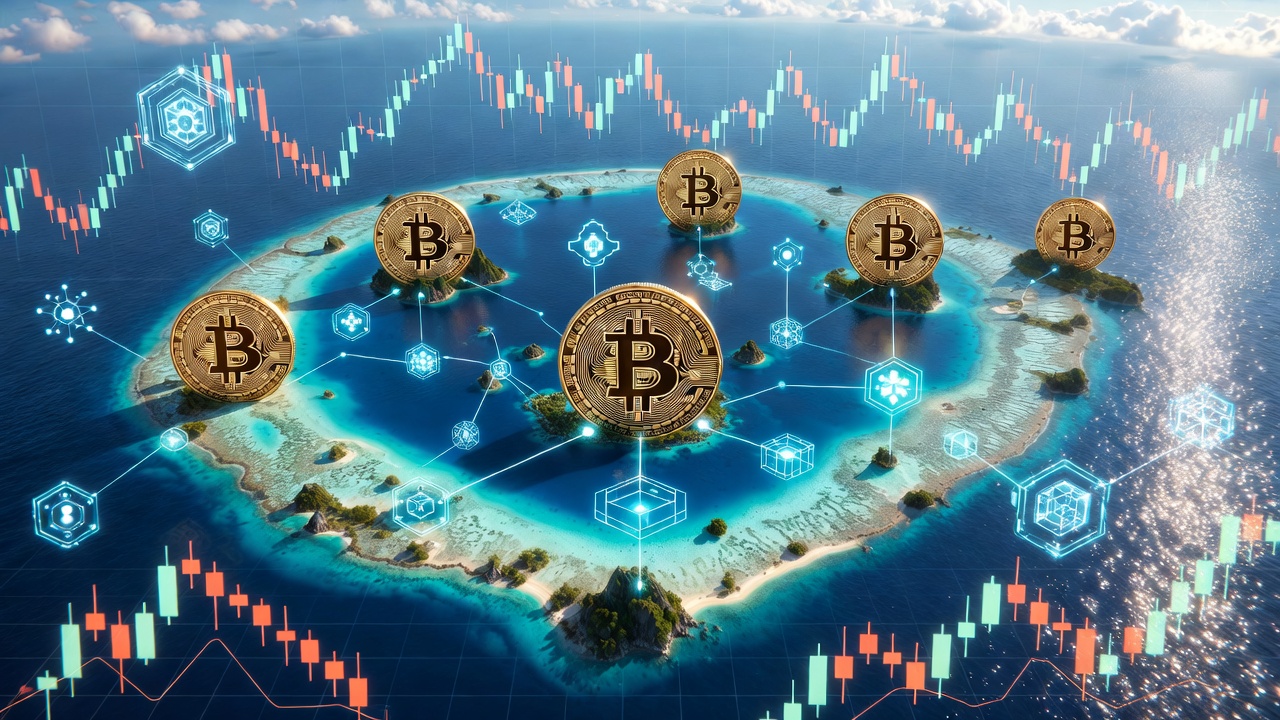
The Republic of the Marshall Islands has rolled out the world’s first national universal basic income program with a blockchain-based payment option, drawing attention from crypto-linked infrastructure firms and sparking debate among international financial institutions.
Blockchain Meets Social Policy
Under the initiative, known locally as ENRA, every resident citizen receives quarterly payments of approximately $200, totaling $800 per year. The program is funded through the Compact Trust Fund, a vehicle established under a long-standing agreement with the United States, partly aimed at compensating the Marshall Islands for decades of nuclear testing.
The fund currently holds more than $1.3 billion in assets. Recipients can choose to receive their payments via bank deposit, paper check, or through USDM1 tokens delivered to a government-backed digital wallet called Lomalo.
USDM1 is a U.S. dollar-denominated sovereign bond fully collateralized by short-term U.S. Treasury bills and issued on the Stellar blockchain. The Stellar Development Foundation and crypto infrastructure provider Crossmint partnered with the Marshallese government on the technical rollout.
Addressing Banking Gaps Across Remote Atolls
The crypto payment option was introduced in response to persistent challenges in banking infrastructure. Since 2008, the Marshall Islands has lost approximately 700 correspondent banking relationships, according to a white paper published by the Ministry of Finance. Citizens on remote outer atolls often rely on infrequent physical cash shipments and long-distance water travel to access funds.
Finance Minister David Paul explained the rationale behind the program’s design. “We, the government, want to make sure no one is left behind,” Paul told The Guardian, adding that the payments are intended as a social safety net rather than a replacement for employment income.
Satellite internet connectivity provided by Starlink has helped enable digital transactions in communities that previously had limited online access.
Adoption Remains Modest
Despite the innovative delivery mechanism, uptake of the crypto option has been limited. According to the Marshall Islands Social Security Administration, roughly 60% of first-round payments distributed in November were via direct bank deposits, with the remainder issued as bank checks.
Only about 12 recipients opted to receive payments in USDM1 during the initial cycle. Dr. Huy Pham, an associate professor and crypto-fintech lead at RMIT University, described the initiative as a global first. He noted that using blockchain technology nationwide for UBI delivery is highly unusual.
IMF Raises Concerns
The International Monetary Fund has voiced reservations about the program, citing potential financial stability and macroeconomic risks for a small island state with limited regulatory capacity. The IMF previously advised against a 2018 attempt by the Marshall Islands to launch a national cryptocurrency.
The program has so far reached more than 33,000 citizens, with participation expected to rise to nearly 40,000 in future installments. Whether the blockchain component gains broader traction will depend on merchant acceptance, digital literacy, and continued infrastructure investment across the archipelago.