

This preview of weekly data looks at USOIL and XAUUSD where economic data coming up later this week are the main market drivers for the near short-term outlook.
Highlights of the week: UK unemployment & GDP, US inflation & PPI
Tuesday:
- UK unemployment rate at 08:00 AM GMT. The market consensus is that the figure will be increased by 0.1% for the month of March reaching 4.5%. This might not have a major effect on the pound since the data might already been priced in and the change is not very influential.
- US Inflation rate at 12:30 GMT where the yearly figure is expected to remain static at 2.4% for the month of April. At the same time core inflation is also expected to remain stable at 2.8%. This data is rather critical at this point in time because interest rates probabilities have shifted and a surprise on the actual figures of inflation could create more fluctuations in the probabilities of a cut or stability of the rates in the upcoming fed meetings.
Thursday:
- British GDP growth at 06:00 AM GMT where the annualized figure is expected to decline from 1.4% to 0.5% and the monthly figure from 0.5% to 0.1%. If these expectations are confirmed then the pound might witness some short term losses against other currencies traded against it but no major moves are anticipated since the data is for the month of March and could be already priced in.
- U.S Producers Price Index (PPI) at 12:30 PM GMT. Market participants are expecting the figure to come out at 0.2% over-0.4% of the previous reading. If this is confirmed then it could potentially hint to potential higher inflation figures in the coming months since higher producers’ costs usually roll down to consumers pushing inflation figures to the upside.
- Japanese preliminary GDP growth at 11:50 PM GMT where the annualized figure is expected to drop from 2.2% to -0.2% and the quarterly figure from 0.6% to -0.1%. If these expectations are confirmed then the Japanese Yen might witness some short term losses against other currencies traded against.
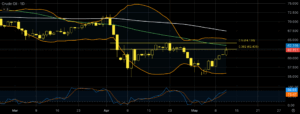
Oil prices rose on Monday as optimism grew over U.S.-China trade talks, which both sides described positively, boosting market sentiment. Brent crude reached $64.34 and WTI hit $61.50, building on last week’s gains—the first since mid-April. Investors are hopeful a trade resolution could restore global crude demand, however, gains were limited by OPEC+ plans to increase output and ongoing uncertainty around U.S.-Iran nuclear negotiations. In addition to the supporting factors, a drop in U.S. oil rigs also added a boost to the prices.
On the technical side, the price rebounded rather aggressively after finding strong support on the lower band of the Bollinger bands. Currently, the price is testing the resistance of the 38.2% of the Fibonacci retracement level just below the $63 price area, which is also the 50-day moving average line. The moving averages are validating the bearish trend, and at the same time, the Stochastic oscillator is in the extreme overbought level. Both of these indications are favoring a bearish scenario in the upcoming sessions, which, if it becomes reality, then the first area of possible support might be lying around the $60 mark, which consists of the psychological support of the round number as well as the 23.6% of the daily Fibonacci retracement level.
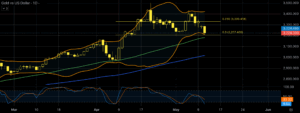
Gold prices are falling due to improved market sentiment after the U.S. and China reported “substantial progress” in their Geneva trade talks, reducing demand for gold as a safe haven. Despite this, the downside is limited as markets await a joint statement from the talks. Ongoing geopolitical tensions—India-Pakistan ceasefire threats and Russia’s rejection of a Ukraine ceasefire proposal—continue to support gold. Additionally, unresolved U.S. trade disputes with Japan and the EU, including threats of EU countermeasures, remain key risks that could limit further gold losses.
From a technical point of view, the price of gold has reached $3,400 late last week and has since corrected to the downside. Currently, the price is trading at a rather major technical support area around $3,200, which is made up of the 50% of the daily Fibonacci retracement level, the lower band of the Bollinger bands, as well as the psychological support of the round number. The Stochastic oscillator is on the move to reach oversold levels while the moving averages are showing the bullish trend is still valid. Based on these indications, there might be a bullish correction in the near short term, possibly a retest of the area around $3,300 or even higher.
Disclaimer: the opinions in this article are personal to the writer and do not reflect those of Exness or Finance Feeds.
This content is the opinion of the paid contributor and does not reflect the viewpoint of FinanceFeeds or its editorial staff. It has not been independently verified and FinanceFeeds does not bear any responsibility for any information or description of services that it may contain. Information contained in this post is not advice nor a recommendation and thus should not be treated as such. We strongly recommend that you seek independent financial advice from a qualified and regulated professional, before participating or investing in any financial activities or services. Please also read and review our full disclaimer.