
For the first time since June, Bitcoin (BTCUSD) dipped below $100,000 on Tuesday. In New York trade, it sank to a four-month low of $96,794. The dip puts the world’s biggest cryptocurrency firmly in bear-market territory, down about 20% from its peak of $126,000 in October.
It wasn’t just crypto that fell. AI-related tech firms, which have been a big part of the risk surge in 2025, also lost a lot of value. Nvidia sank 4%, and Palantir fell 8%, even though their earnings were better than expected. The coordinated drop in speculative assets shows that investors are becoming less optimistic and that high prices may not be able to stay high just on promises.
According to analysts at Octa Broker, the $100,000 level for Bitcoin is more than just a technical line; it’s a psychological barrier that shows how confident people are in the market’s ability to bounce back. The most important question today is whether this is a healthy consolidation before the next step up or the beginning of a larger unwinding of speculative excess.
When Bitcoin and tech stocks go down at the same time
The most recent drop in Bitcoin prices is similar to the drop in high-growth tech equities, especially those related to artificial intelligence. Investors in these assets are similar: a lot of individual investors, a lot of leverage, and prices that are based on feelings rather than facts.
In the U.S., speculative tech stocks plunged the most, while in Asia, South Korea’s KOSPI index sank more than 6% and Japan’s Nikkei 225 fell about 4.5% at their lows. This shows how quickly risk aversion can spread across regions.
According to Octa experts, Bitcoin is becoming more like a high-beta tech company and less like “digital gold.” It is becoming more like a risk asset. When liquidity gets tighter or yields go up, both crypto and growth stocks tend to go down. As the global rise in AI slows down, so does interest in crypto. Both markets are now moving in the same direction as investors pull back from risky subjects.
Four Main Reasons Why Bitcoin Fell
1. The use of leverage will end after the record liquidation in October.
The $19 billion liquidation of overleveraged long bets in October is still having an effect on the market. Futures open interest is still low, and even though financing rates have returned to normal, traders are still afraid to take up large holdings. With less liquidity, even modest waves of selling can cause big swings in prices, which makes the downside pressure even stronger.
2. Lower demand from institutions and outflows from ETFs
The mood of institutions has gotten a lot worse. Between October 29 and November 3, spot Bitcoin ETFs like BlackRock’s iShares Bitcoin Trust (IBIT), Fidelity’s FBTC, and Grayscale’s GBTC saw a total of $2 billion in net outflows. These redemptions don’t show fear; they show people taking profits and resetting their portfolios after the ETF-driven rise earlier this year.
The lower inflows of ETFs have made exchanges less liquid, which has weakened Bitcoin’s price support even while the overall economy is stabilizing.
3. Whale Selling and Less Participation from Retailers
Big holders, sometimes known as “whales,” have also started selling off positions. Since June, more than 1 million BTC have left long-term wallets. This means that people are taking profits at the cycle highs. Meanwhile, retail involvement has stayed the same, with new inflows lagging significantly behind levels seen in early 2025. The last correction has been worse because to the mix of whale distribution and low retail demand.
4. Big and Political Problems
In the past, President Trump’s support for cryptocurrencies has bolstered optimism. However, recent political unrest, such as Democrats winning important elections and the present U.S. government shutdown, has slowed down possible regulatory progress for digital assets.
At the same time, inflation in the U.S. rose to 3.0%, which made people less likely to expect the Federal Reserve to decrease rates in the near future. The chance of more easing has gone down from 90% to less than 70%, which has raised the value of the U.S. dollar to a three-month high and made it harder for people to get money throughout the world.
This macro environment has damaged assets that don’t pay interest, like Bitcoin, and put pressure on stocks that are growing quickly. The market is being careful because of higher real yields, budgetary limits, and slower government expenditure through the Treasury General Account (TGA).
Should I buy or not?
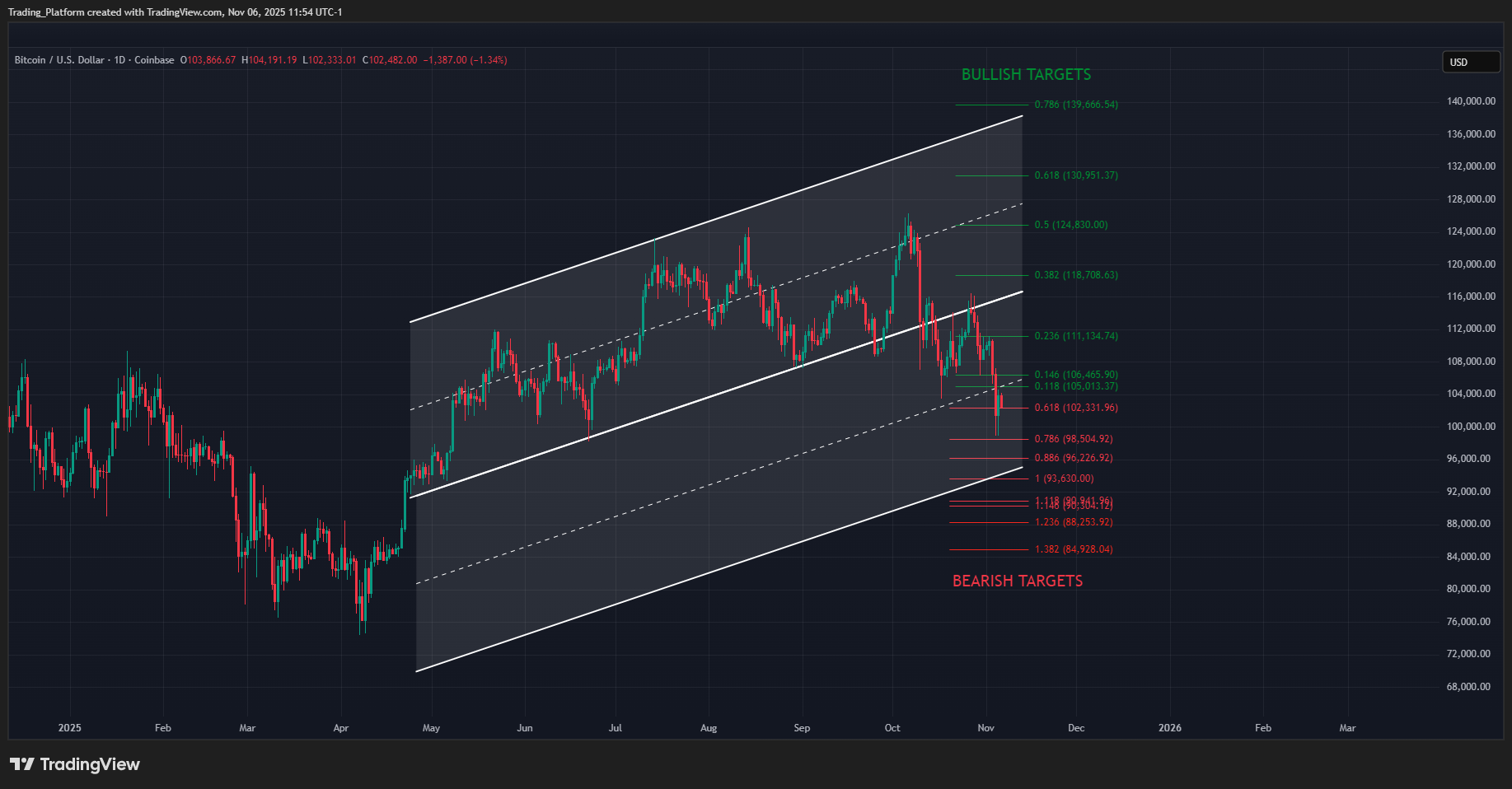
After a big decline on Tuesday, Bitcoin tried to bounce back by going back above $103,000 on Wednesday and staying close to the important $100,000 mark. If the present floor breaks, Octa experts say that the next crucial technical support level is $96,200.
ETF outflows have slowed down, which is a good sign, and the market is still fairly liquid. This suggests that the worst of the panic selling may be past. In the past, prices have tended to go back up within two weeks when liquidity stabilizes.
Still, Octa warns that the short-term prognosis is still unclear. Bitcoin’s long-term potential is still strong because of structural factors like more institutions using it, better ETF infrastructure, and clearer rules. This slump may not be a reversal of trend, but rather a necessary correction that gets rid of leverage and brings speculative excess back into balance.
Bitcoin is still up over 10% this year, even after the current selloff. This is better than many other types of assets. Long-term investors can see the present range as a good place to build up their positions, while short-term traders should stay disciplined even though the market is still volatile.
The Crypto Fear & Greed Index has dropped to 24 (Extreme Fear), which shows that the market is still quite nervous. Octa analysts say you should wait for a verified reversal trend before getting back in aggressively.
From: Octa Trader and TradingView
Bitcoin is still holding steady just above important support levels. Momentum oscillators show that the market is oversold, but a bounce back will depend on getting back above the $106,000–$108,000 zone, which was support in early October. If the price stays below $96,000, the next target on the downside would be about $92,500.
In short
Bitcoin’s drop below $100,000 is similar to a larger drop in speculative assets, which is happening because of tighter liquidity, political uncertainty, and a general aversion to risk in global markets. Octa Broker, on the other hand, sees this period as a possible reset rather than a breakdown, with the long-term fundamentals still in place.
Institutional and high-net-worth investors often start buying again after periods of turbulence. When leverage unwinds and ETF flows return to normal, the future will probably depend on macroeconomic signals, especially U.S. inflation statistics and changes in central bank policies.
It’s still smart for traders to be careful while keeping an eye on important technical levels. If confidence comes back, the $100K mark might once again be the base for Bitcoin’s next rise.
Disclaimer: This post is not investment advice and does not take into account your financial condition, goals, or needs. You are the only one who can decide what to do with this information, and Octa is not responsible for any losses or problems that may happen as a result.
About Octa Broker
Octa is an international broker that has been around since 2011. It gives people free access to worldwide financial markets. Octa has more than 61 million trading accounts in 180 countries. It gives traders throughout the world access to innovative platforms, analytical tools, and educational materials. The company is also involved in global humanitarian projects that focus on education, infrastructure, and helping communities.
Disclaimer: This sponsored market analysis is provided for informational purposes only. We have not independently verified its content and do not bear any responsibility for any information or description of services that it may contain. Information contained in this post is not advice nor a recommendation and thus should not be treated as such. We strongly recommend that you seek independent financial advice from a qualified and regulated professional, before participating or investing in any financial activities or services. Please also read and review our full disclaimer.