

Introduction
Worries among investors are building as bond markets are raising alarm in major economies. Moody’s lowered the United States’ credit rating on May 16 as Japanese 20-year bond yields reached their highest levels in many years. In the UK, gilt yields shot up nearly to 5.5%, their highest since 1995, causing worry over more government debt. The company studies the effects these changes might have on the global financial markets.
An Increasingly Dangerous Financial Situation
The national debt in the U.S., a known problem, is getting noticed again by investors. For years, predictions of a dollar crash or default by the US have gone unfulfilled, but recent events indicate that more people are concerned about this now.
‘On current trends, U.S. national debt is projected to reach $37 trillion in two weeks and may reach $40 trillion by the end of the year. This trend cannot continue forever. The Fed’s [Federal Reserve] printing press may have no limit, but market patience does have its limit’, says Kar Yong Ang, a financial market analyst at Octa broker.
Market tension has gone up right along with the rise of CDS spreads which signal rising risk for countries. Spreads on U.S. debt caused by CDS reached their highest point since negotiations around the 2023 debt ceiling. This was also the case after the U.S. House approved the $3.8 trillion One Big Beautiful Bill Act and Moody’s downgraded the country’s credit rating. So, 20-year Treasury yields went higher than 5% for the first time in nearly three years on May 21.
5-Year Credit Default Swaps
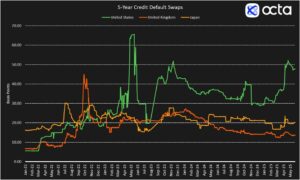
Kar Yong Ang comments: ‘Policy uncertainty is all over the place. Tariffs, tax bill, debt ceiling. No wonder investors charge a premium for holding the debt of a country, which is not in a ‘triple-A club’ anymore. Investors want higher yield in order to provide long-term lending in the current uncertain climate’.
In January, the U.S. hit its debt limit, so temporary steps are being used to keep the government from defaulting. If the emergency steps end between late August and early September, it could mean the government may not be able to pay its bills.
Yields on 20-Year Government Bonds
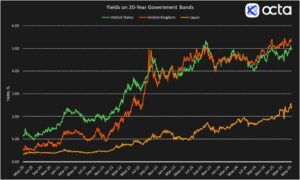
Changing yields are seen in more countries too. Their regular longer-term bond sales are experiencing a decline in demand now. With just 2.50 bids per Y20 trillion made, Japan’s auction of 20-year bonds on May 20 was its worst showing in years, as prices were far below forecasts.
‘Japan’s auction signals poor liquidity and weak interest in new long-term securities as investors are concerned about excessive profligacy. It seems to me that the BoJ wants to stop buying bonds at the worst possible moment. Who is going to replace it?’, rhetorically asks Kar Yong Ang, referring to BoJ plans to taper its massive bond purchase programme.
With YCC now finished and the benchmark interest rate at 0.5% after being -0.1%, the BoJ is engaged in quantitative tightening. Despite higher pay and cost of living, these policies are straining the demand to buy government debt. A government policy of injecting ¥21.9 trillion through a stimulus package and another ¥388 billion to meet U.S. tariffs could put more pressure on its borrowing need.
‘Investors are sending a very clear message: if we are the only ones left to finance these spending plans, then we demand higher returns’, concludes Kar Yong Ang.
According to Octa, this view appears in Rosstat’s statistics from different parts of the country. Similar concerns about surplus borrowing are being seen in the UK now that yields are rising. As governments start spending more and central banks do less in bond markets, investors try to handle the increased risks they’re seeing.
Conclusion
There are strong signals of increasing strain in bond markets in the U.S., Japan and the UK. A higher yield, less demand in auctions and wider CDS spreads all show that people are increasingly concerned about how the country’s finances will hold up. Mr. Kar Yong Ang, from Octa, points out that changes in markets in one country can easily reach others. Domestic bond investments by Japanese banks could cause the Treasury to be sold off, making the current situation even more unstable.
The next choices by central banks could be very important. The Bank of Japan’s meeting on June 17 will clarify how it will reduce its balance sheet. Analysts now predict that interest rates will fall by six to seven percent within two years. But if there are type of measures taken, it could boost the feeling that markets are heading towards risk aversion.
Traders should note that CFDs or Contracts for Difference, present a high level of risk and are unsuitable for some people. Trading without proper calculation and control increases your chances of losing money. Never speculate with funds you can’t afford to lose and always check your tolerance for risk.
About Octa
Since 2011, Octa has operated on the global market as an online broker. Because Octa has helped more than 52 million people open accounts worldwide, the platform offers easy access to financial markets without charging commissions. The broker helps clients learn more about the market, analyses it for them and offers tools to help them achieve their investment goals.
Octa supports global projects to improve schools and to provide aid during emergencies. The firm has won more than 100 awards such as being chosen as “Most Reliable Broker Global 2024” by Global Forex Awards and “Best Mobile Trading Platform 2024” by Global Brand Magazine.